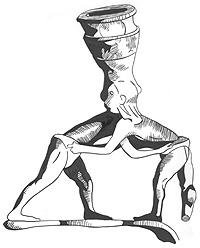
Sophocles, Odipus Rex
“God is my help and hope, on him I wait.”
-Chorus
“Apollo, wolf-lord.”
-Jocosta
“The mortal man, the sport of Fate.”
-Jocasta
“My business is to tend the mountain flocks—I loosed the pin that riveted thy feet.”
-The Corinthian Messenger
“He was a herdsman of the King.”
-The Corinthian Messenger
“Though I be proved the son of a bond-woman.”
-Oedipus Rex
“I who rank thyself as fate’s favorite child.”
-Oedipus Rex
“I was a thrall, not purchased but home-bred.”
-Herdsman, Shepherd of the Cytheran Range
“Oh best of masters, what is my offense?
For mercy’s sake, abuse not an old man!
Forebear, for God’s sake, master.”
-Herdsman,
“Slave born, or one of Laeus’ own race?”
-Herdsmen
“Fearing a dread weird…
T’was foretold he would slay his own sire.”
-Herdsmen
“Races of mortal man,
whose life is a mere span,
I count ye but a shadow of a shade…”
-Chorus
Ernst Younger
On Alexander and Kings from Eumeswil
“Furthermore, an outstanding personality makes them [liberal historians] squirm. Alexander strikes them as an elemental phenomenon, a lightning bolt that is sufficiently explained by the electrical charge between Europe and Asia. There are bizarre congruences between liberal and heroic historiography.”
-Eumeswil, page 11
“Murder and treason, pillage, fire, and vendetta are of scant interest for the historian; they render long stretches of history—say Corsican—unfruitful. Tribal history becomes significant only when, as in the Teutoburger Wald, it manifests itself as world history. Then names and dates shine.”
-Eumeswil, page 107
“How life is dim, unreal, vain,
like scenes that round the drunkard reel…
A drop in Ocean’s boundless tide,
unfathom’d waste of agony;
Where millions live their horrid lives,
by making other millions die.”
-Sir Richard Burton, circa 1870, as quoted by Ernst Junger
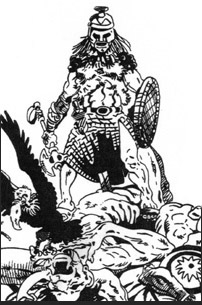
“Antigonus; he led the elephants in the center; his son, in the right flank, led the cavalry. Both died in battle: the father was not found until several days later when the vultures were already at work; however, his dog was still guarding the corpse.”
-Ernst Junger, paraphrasing Polybius, on one of Alexander’s successors, who the Agrianes fought for in said Battle of Ipsala, in Eumeswil, page 193 & 94
…
King David’s Harp, Selected and Adapted from Psalms
Prayers to ward off enemy intent, addressed to the Almighty, were the most common pre-battle recitation among those that plead their mortal case to the Savior of Thunder. [Zeus-Soter] The first two Psalms below are not of David, included to establish a standard. The King James text has been truncated to better reflect concise ancient Greek.
“The ungodly are not so,
but like chaff driven before the wind.”
-From Psalm 1
“The kings of the earth feast,
The rulers take council against God
And against his anointed, saying:
‘Let us break their bands and cast off their chords,’
Yet God Above laughs.”
-From Psalm 2
“Upon the wicked he shall rain fires and brimstone…”
-from Psalm 11, by David
“...As silver tried in an earthen furnace
purified seven times,
Keep them, oh God,
Preserve them from this generation,
when the wicked walk on all sides
and the vilest men are exalted.”
-from Psalm 12, by David
“For they intended evil against me;
They imagined a mischievous ploy—
which they are unable to employ,
Therefor shall God strike them with fear,
when He strings His arrows in their face.
Exalted is God All-powerful.
We sing and praise God Almighty.”
-from Psalm 21, by David, a war hymn, adapted to arete sensibilities
“There will I [God] make the horn of David to flower,
I have a lamp for mine to ordain.
His enemies will I clothe with shame.
But upon him will his crown shine.”
-Psalm 132, David, a Psalm of Degrees, Preamble to Temple Dedication
…
David Evan’s Harp, Selected from Boundover [1]
“As a feeble shepherd,” of but 8 or 9 years, Evans was bound to a weaver who was also an accomplished bard.
“Leading a youthful life of folly,
Like a wild ass’s foal.
“Meditating sadly on my condition,
God put it in my mind to put all aside…
“Until the Devil by crooked means
Kindled a blaze of devilish plots.
“So that there was no sign of peace,
Alas! Nore hope of a quiet life.
Evans survived bondage, toil and feud, to one day find a young woman to marry. His final lines concern having found her, and suggest, that perhaps some old footsore war-fighter of Alexander, met a maiden along the way, and at length settled down with his harp, perhaps to recite a yarn that would resonate with wife and daughter. For many acts of kindness to women were recorded in the popular tradition of Alexander, and much of what remained beyond the grasp of the jealous sophists maintained or took on the form of romance.
“During all the strife and tribulation,
And into the present she yet nurses me
Lovingly, in my gray-haired debility.”
Oswald Spenglar on Tragedy & History
The Decline of the West, Chapter 4, The Problem of World History, The Idea of Destiny and the Principle of Causality. Spenglar ruminates on the opposition of the destiny idea and the causality principle, on “world building,” providing a “fate-laden” vision of life. Tyche, “luck” or “fate” is revealed as the most popular working class deity of Hellas, above as well that of Cythera [Moon] and Helios [Sun] were not certainly contacted deities; further, that the majority of Greek gods were regarded as tied to places, activities and elemental being.
Causal thinking is explained as an outcome of “law,” that “real history is heavy with fate, but free of laws,” remarks the Germanic sage. The systemic, causal thinker, the academic, is, to Spenglar, obsessed with the static “become” in favor of dynamic “becoming,” and has difficulty penetrating the fabric of human action embodied by the “man of action,” and inherently grasped by the primitive man, the cultural man, a realm of appreciation which scientific thinkers are barred from understanding by “their army of abstractions” in “the stiff dead principle of cause and effect… of tyrannical thinking.” Oswald’s explanation of destiny and time, of great actors such as Alexander as embodied tools of the tidal and cataclysmic forces of the higher and deeper world, finally permitted this pulp writer to fathom the subject of the Areid, and of our modern view as that of “an antifate” crippled from accessing the window that might grant us an empathetic view of Antiquitous Man, in particular that of a youth becoming a man organically, rather than the process of evolving into a pre-constructed role. “Causality, which is the existence mode of objects… kills all that is organic and fateful.” He reminds the writer that primitive man is recreated in the life of “a child,” as he rises, “in primitive wistfulness,” to “take on the living garment of the deity…”
This statement, reinforced the narrative premise of depicting Alexander, King at Twenty, and his rampant battle to the ends of the world, from the perspective of youths who were themselves “becoming.” With seven sons of man to cloth in mirror shades of their heavenly creator, the necessity of a novel length prologue to the seven novel Areid became heavily obvious. Spenglar discusses the Alexander Principle, via Napoleon, most tellingly when the Corsican conqueror names himself an instrument of fate just before his disastrous invasion of Russia, in the context of his better designs having been thwarted by very minor accidents, such as a landing of a few guns at Acre, a battle space he shared down time with Alexander.
Notes
-1. by John Van der Zee, 1985, NY, pages 135 to 144