Prior to the 16 instructional chapters;
1-4 on Biological Equipment
5-8 on Ancient Instruction
9-12 on Navigating a world of sinister curation
13-16 on rediscovering and engaging higher worlds,
The subject is reminded of his basis.
Metis
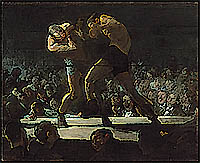
Between the two scenes in a fabricated story resides a potential abyss to be navigated. This juxtaposition, in our world operated by evil forces cloaked as entertainers, is defined as “operative” space, the place owned by Philostratus [1] as as he instructed his students in Pictures in a Gallery, gliding between one and the other. Quintus Smyrneus, in his Fall of Troy [2] describes the use of boxing as a rite of induction as “The quick play of cunning hands.”
“The working of the crowbar into the margin space,” provides the fictional reference for this work of overt nonfiction, providing Andrew, our messenger, his margin space. Technique, expertise, knowledge, as it is worshiped today is deftly shunted aside for metis, an aspect of Arete embodied by such men as Odysseus in Antiquity. The ancients warned against the corruption implicit in the pursuit of mere techne. When Isomachus [3] warns Socrates against taking up a manual trade, he speaks of deformation of body and mind. Artisans were slaves for a reason, so that his visionary master would not be bent to a functional groove. [0] Likewise, when Phillip the King reprimands Alexander the Prince for pursuit of musical excellence, he warns against specialization. But, as his exploits and rites proved, Alexander was training for mass conduction, for his quest for transformation, having never abandoned his childish metis in the face of the machinating adult palace. [Likewise his taming of Bucephalus.]
Branching from modern philosophers’ working in Antiquity through the Latin prism, the author uses the term “game,” perhaps as a diversion to throw counter-investigators off his trace. For “game” denotes lack of inner gravity, lack of the sacred, lack of divine focus. Game and games has been used by Modern European thinkers to translate two classes of rite that far exceed any modern notion of play, of interactive risk management and contrived secular power struggle. Ancient Greek Agons, were sacred contests dedicated to, and striven before, the higher powers. Their analogue for a game would be playing ball with their women and children. The mortal duels of the Romans, dimunitively impugned as “games” today, were munera, rites due the dead, in such a way as to provide lessons for the living. It is apparent that the author has in mind these deeper contexts, not the caged play of the modern “game” mind.
The author’s observations on the inherent functional wisdom of children, is lost to so many of our fellows, who fail to hold an awareness of our conducted decline downward into darkness from bright childhood. For so few of our fellows have children and many who do so, take the codex brutal in hand and obey the religious axioms that declares the natural child an enemy that must be forcibly colonized.
I recall, all in one day, a cold January morning of 1991, at about 10:00 AM, on Luerssen Avenue, in Baltimore City, attending my six month old son in the front yard. He was lightly dressed as was his dad. He made three discoveries that morning. He gave over the fledgling attempts at crawling and went to hand walking, cruising out onto the concrete sidewalk. He then found a stick that had blown out of the neighbor’s tree and began, wide-eyed, constructing it in his mind to some assertive purpose, looking at a squirrel venturing to the ground on the unseasonably warm day and seeming to wonder if this stick could bridge their mobility gap. Then he looked up at the moon, almost full in the deep blue late morning sky, and said, “M, mh, moo, Moon!”
And so my youngest discovered the gravity of his marooned situation and related it to the system meat-bot towering above him, the prole assigned to crush his wonder. In old age my saddest conversations have been with Christian Church ladies, all protestants, some mothers, some Barren Karens, possessed of the very vocal opinion that no child may be brought to Christ until he or she has been spanked, beaten, scolded, punished and otherwise deprived of the naturally arising devils implanted at birth, as if The Enemy brought new souls into the world rather than God. I have sat for sermons on such, with sacred references on why one must beat the children.
The author, in Metis, simply points out that the natural metis of children is compromised by lack of discernment. But, traditional beliefs that have clung to us in this Cage System must make peace with the whip hand reflex and ordain it. Christian Indians in the Pacific Northwest [2025, interview with Dog Soldier], as late as the 1980s, had rites in which the child was spanked on a blanket before the congregation, in a blatant attempt to interface with Beast System anti-culture.
On page 16 of Abstract Operator the activation of “dials in heaven and hell,” bring to mind the plight of Job and of Goethe’s Faust. The author’s suggestion to watch cats was given to me by another while residing in rain forest Cougar Country, which happens to be home to the author. The Major said, “That cat [4] gliding along the back of that chair, scale that up to 250 pounds, and that’s what’s waiting for you and your knife on the other side of the mountain.” The dials are described more like event horizons by Evola in Metaphysics of War.
Edwards points out, “Time, space and identity are all co-regulated, inseparable, and necessary for each other.” Thus the genius of Modernity, the erasure, corruption, negation and re-allocation of identity, inflicts a critical imbalance upon each and every person defined by the Beast System.
Metis is described in terms of music by the author. I propose, because I prefer, the silence of the broken dance, of combat. Having spent 40 years helping karate fighters, who own superb technique but cannot effectively fight in free flow, how to adjust through the cultivation of the time, measure, rhythm and sensory adjustment core to boxing and dueling, the reference of music fits, clicks. Not a musical person, never having played or sung a note, having been jailed for weeks in a dark room in 8th grade for refusing to sing in music class, this stranger has found more endurance in training, laboring and writing while in sleep-deprived states, by using music as an energy modulation conductor. Unable to recall a song title or lyric to even my favorite song, I recognize the motion of those few songs when I happen to hear them. For I do not, ever, play a song through this machine or others. The author reminds this reader that, I tonelessly understood when I found the carving in sketch of the two Babylonian boxers crossing fists to the music of an “Illisu’ drum.
“Metis is required for the passage,” writes the author, bringing to shadow in this reader’s mind an image of Odysseus, man of many wiles, living within and beyond Odysseus the King, Lord of Ithaka. Andrew Edwards has crafted a handbook for journeying back into our own usurped lives, retooling those maligned identities, reminding us that we are challenged with a passage whose toll-keepers require more than the sordid fruit of mortal accumulation. [5]
Notes
0.) See Alexander’s dedication to the 38 fallen Macedonians with individualized heroic statues executed by the best sculpture of the age. We might call Polycrates [check name spelling] free. Yet he had no choice but to accompany his Hegemon into wicked Asia, 334 B.C.
1.) circa A.D. 220
2.) circa A.D. 450
3.) Xenophon, Estate Management, circa 370 B.C.
4.) Annie in the novel American Dog
5.) Gene Wolfe’s priestly protagonist in Litany of the Long Sun comes to mind