Sons of Apollo
Plato’s relatives claimed that he had been fathered by a shade of Apollo who had “fantastical congression” with his mother Perictione.
Alexander’s esoteric biographer, Plutarch, claimed that Phillip peeked into Olympias’ room and saw her having sex with a python, an incarnation of Apollo, and that Alexander was only half mortal, on his mother’s side.
Sons of Herakles
Theogenes, the boxer of Thasos, whose father was a priest of Herakles, was said to have been fathered by Herakles taking possession of his father during congress with his mother.
Macedonian Kings where all chosen from the bloodline of Herakles, who was believed to have dallied in that region after separating from the Argonauts. There seems to have been three Bronze Age/Dark Age warlords by the name of Herakles.
Sons of Water
Achilles was fathered by the hero Peleus on the nymph Thetis.
Glaukos, the boxer of Karystos, was said to have been a son of the sea, which was understood to be a masculine element, his name meaning “Greyfish.”
Euthymus was said to have been sired by the river his mother bathed in. Rivers were again, masculine forces.
Son of the Moon
Aeneas of Troy was said to have been born to Aphrodite, making his father one lucky mortal.
Cases of Ascension
Half mortal heroes were favored with better options in the afterlife, in particular if they suffered a great deal, to include Dionysus [Bacchus], Herakles and Euthymus. Achilles, tragically, condemned by his embracing of his rampant nature, earned the captaincy of the forlorn slain collected as shadows. Odysseus, though mortal, suffered so much, that he would be granted that which was reserved for demigods, as discovered by Er of Pamphylia, as related by Plato, translated by Banjamin Jowett, courtesy of Steve Richards in the Traveler’s Guide to the Astral Plane.
Heroes Who Chose Another Incarnation
Er’s story seems to come down from the Dark Age period, following the Bronze Age Collapse, of which the Trojan War was the pivotal event in the ancient consciousness. Pamphylia is a small area of southwestern Asia Minor exactly where Arrian’s Book 1 of Alexander’s Expedition, ended. Bounded by Lycia to the west, Psidria to the north, and Cilicia to the East, Pamphylia—being coastal as well—would have suffered much during the age of migrating warrior nations.
There was a great battle. The bodies were not collected for 10 days, which indicates a time of social crisis far beyond the norms of a border war. Er’s body was found to remain fresh, not rotten. On the 12th day, as he was lying on the pyre [again, indicating great antiquity] as the Greeks of Plato’s time were buried, Er woke, just in time! [1]
Er journeyed to a mysterious realm with “a great company.” Here were judges seated in an intermediary space between two stairways, to and from, Heaven on the right and two stairways to and from the Underworld, or “earth,” to the left. He was told that he was not to participate but to serve as a messenger to men from the “Other World.” The wicked descended for their various sentences. The just ascended for their various deeds.
The descending stairway from heaven and the ascending stairway from the underworld then emitted souls. On one hand ascended from the earth, having weathered their punishments, souls “dusty and worn with travel.” On the other were those descending from heaven “clean and bright.” There was a great festival where those from underworld and overworld consulted one another.
On the 8th day they must journey. On the 12th day they arrived at a meadow below a bright, pure rainbow, a column of light intersecting heaven and earth. The 13th day saw them gain the place of the light where the chains of heaven were anchored. Plato seems to describe the Milky Way, Ovid’s and David’s “Highest Heavens,” “For this light is the belt of Heaven and holds together the circle of the universe, like the undergirders of a warship. From this end is suspended the spindle of Necessity from which all the revolutions turn.” [2]
Though it seems as if we are being treated with a prefiguring of the Medieval Christian afterlife, Er makes a hard left turn towards India.
Necessity was the mother of the three Fates, sired on her by Zeus Almighty. Her daughter, Lachesis, the fate who sings of the past, has upon her lap “lives and sample of lives.” A prophet officiating from a high pulpit declares that the souls will draw lots, and in order, choose the guiding genius of their lives, the condition of their birth. He finishes his sermon with, “...the life he chooses shall be his destiny. Virtue is free, and as a man honors or dishonors her, he will have more or less of her. The responsibility is with the chooser—God is Justified.”
Agency is granted to the dead, both to those who have been rewarded or punished. Animal lives were available, and of men in every plight. One might chose to be a tyrant. It followed that the souls pampered in heaven tended to choose naively and those improved in the underworld through punishment often chose better. Those who have their mind “darkened with sensuality,” wanting earthly pleasures, tended to choose poorly. This recalls that Alexander refused sexual intercourse for pleasure, scandalizing his mother, who arranged for the most beautiful whore in the world to unburden him of his virginity. He was a student of Aristotle, student of Plato. He was exercising care to the extent that it is obvious he was well-versed on the lessons Er brought back from the Other World. In Alexander’s abstinence, the modern mind sees a homosexual. The ancient mind saw a man that could deny himself pleasure now in hopes of earning the highest regard of those who judge in Heaven, which was Alexander’s central pathos.
Two heroes and a heroine are named. The heroin, Atlanta, who lost in wrestling to Peleus, was jilted by Herakles and slain by a man, chose to be a great athlete and suffered from her short sighted choice. “The soul of Epeus,” the champion boxer who designed the Trojan Horse, chose an interesting life, “passing into the nature of a woman cunning in the arts.” Odysseus, having suffered such woe in life, wandered about in search of a life of a man with no cares. Picking up the last lot, overlooked by those who had not been cured of ambition, he was perfectly happy.
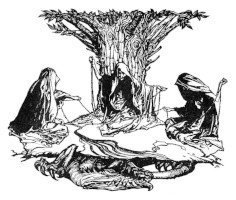
Each soul went to Lachesis, who assigned them their guardian genius, who led the soul to Clotho, the spinner of Necessity’s spindle. They were then fastened to their destiny by the thread worked in the hand of Atropos, who cuts off lives, all beneath the Throne of Necessity. This places reality as the mother of destiny in Alexander’s People’s ethos.
The souls the marched through a scorching waste to the Plain of Forget and camped by the River Unmindful, “whose waters no vessel may hold.” Compelled to drink, they then shot like stars to all manner of their lives, all except for Er, who was forbidden to drink the waters of forget and woke on his Pyre.
Such was the basic structure of reality perceived by Alexander and his men. In following sections we will examine some of the more brutal and rustic understandings held by his men.
Notes
1.) Richards notes another ancient case in which a supposed dead man woke on a pyre and died in agony.
2.) With Neo-Platonic theologians forming a branch of the primitive Christian church, the structure of the afterlife common to medieval Christendom is here already apparent in the time of Homer & Hesiod, the latest point at which Er was likely to have recounted it, perhaps after a Cimmerian invasion.